
A sump pump has six drawbacks of its own: it needs power, wears out and makes noise, can overheat, opens a hole in the slab, needs an outlet, and costs money twice. A seventh comes from installing one for the wrong reason. In a Barrie basement, a battery backup, a sealed lid, an overheating switch and a clear outlet shrink four of them, while the motor wear and the two bills stay with the house.
The Ontario Building Code calls for a covered sump and an automatic pump only where draining by gravity is not practical. A pump is what goes in when the lot has no slope to do the job, and every negative below is a cost of asking a machine to do what a downhill pipe would otherwise do for free. That is the position. This page takes the drawbacks in the order a Barrie owner meets them, and says which ones a good installation shrinks and which ones stay with the house for as long as the pump does.
| Drawback | Shrinks or stays | The part that shrinks it |
|---|---|---|
| Power | Shrinks | Battery or water-powered backup |
| Motor wear and noise | Stays | High-water alarm, twice-yearly test |
| Overheating | Shrinks | Overheating switch, own circuit |
| Hole in the slab | Shrinks | Sealed lid |
| Outlet | Shrinks | Clear, sloped, unfrozen discharge |
| Two bills | Stays | Planned replacement, insurance check |
| Wrong problem | Shrinks | Ruling out cheaper causes first |
It needs electricity at the worst moment
A pump moves no water without power, and nothing about the pit changes that. The March thaw and the spring storms that raise the groundwater around a Barrie foundation are the same weeks the wind puts branches into hydro lines across Simcoe County, from Innisfil to Stroud. The pit fills fastest on the night the circuit is dead.
This drawback shrinks, and it is the first one we would spend money on. A battery backup pump sits in the pit beside the main pump and takes over when the main one has no power. The Insurance Bureau of Canada recommends a sump pump system “with a battery backup and alarm”. Barrie Fire adds the part that gets forgotten after the first year, which is that a battery backup has to be maintained and charged at all times or it is a box in the corner.
A water-powered backup avoids the battery altogether. It draws on the house supply rather than the grid, it needs municipal pressure and a backflow preventer to do it, and it is not an option on a house that runs on a well.
It is a motor, and motors wear out
Gravity does not wear. A pump does.
Barrie Fire gives sump pumps an average life expectancy of about 10 years. The real number depends on how often the pump runs. The Insurance Bureau of Canada recommends replacing any sump pump that is over 10 years old with a high-quality, appropriately sized pump. A pump in a snow-belt pit runs for weeks every spring rather than hours, so the age on the label understates the work it has done.
The motor also tends to fail without anyone watching. Nobody is standing in the basement when a float rides up and sticks against the liner or a winding burns out, and the first sign of the failure is water on the floor. A high-water alarm on the pit is the cheap answer to that silence, because it turns a quiet failure into a noise somebody hears.
The pump is also loud in ways owners do not expect. The check valve clacks on every cycle, a strained motor drops from a hum to a grind, and a pump that cycles every few minutes in March under a bedroom keeps the household awake.
Maintenance is the price of the moving part. Barrie Fire asks owners to run a hose or a bucket into the pit before the rain comes, in spring and again in fall, and to listen for a pump that starts, runs without strain and shuts itself off when the pit is low. It also asks owners to look into the pit and lift out any debris they can see. When that test does not go cleanly, the checks to run before buying a new pump are on our page for a Barrie sump pump not working.
It can overheat, and Barrie Fire says so
Barrie Fire writes that crews “frequently respond to potentially serious incidents” of overheating sump pumps in homes.
Barrie Fire tells owners to use only a pump with an overheating switch, which it says is standard on new pumps and turns the pump off when it overheats. It tells owners to plug the pump into its own circuit, so a short in the motor trips the breaker before a fire starts. It names a submersible pump as a safer choice than a stem or column style. A pump that keeps cycling on and off is not necessarily heading for a fire, in Barrie Fire’s own words, but the service still recommends a professional look at it.
In our judgment, a pump that cycles every few minutes is the one working hardest, and the motor housing is the part that feels it. The right pump on its own circuit shrinks this risk a long way. It does not take it to zero.
An open pit is a hole in the slab
A sump pit is an opening through the basement floor into the soil under the house. Health Canada lists sumps among the typical entry points for radon, along with floor drains and cracks in foundation walls and floor slabs. Its guideline is 200 Bq/m3. An uncovered pit is also a drowning hazard where small children live.
A smell from the sump pit can be harmful, and the rotten-egg smell is the one to take seriously. The Canadian Centre for Occupational Health and Safety lists hydrogen sulfide as sewer gas, gives its odour as rotten eggs, and warns that it can dull the sense of smell, so a smell that fades is not proof that the gas has gone. The sealed lid is the first fix, because it closes the pit to the basement air, and where the gas comes from is the question after that.
This drawback shrinks almost completely, and the fix is already in the code. Under the Ontario Building Code, the cover on a sump pit has to be sealed, and it has to be built to resist removal by a child. A gasketed lid closes the hole, and a loose board laid across the top of the liner does not. If a radon test in the house still comes back high after the lid is sealed, Health Canada sends owners to a certified radon mitigation professional, and that is a different trade from ours.
The water has to go somewhere, and keep going
A pump does not make water disappear. It lifts the water out of the pit and pushes it up a pipe to the outside, and the place that pipe ends sets whether the water leaves the lot or comes back. An outlet that ends a short step from the wall pours straight into the loose backfill trench, and the same water walks back down to the footing and into the pit for another cycle.
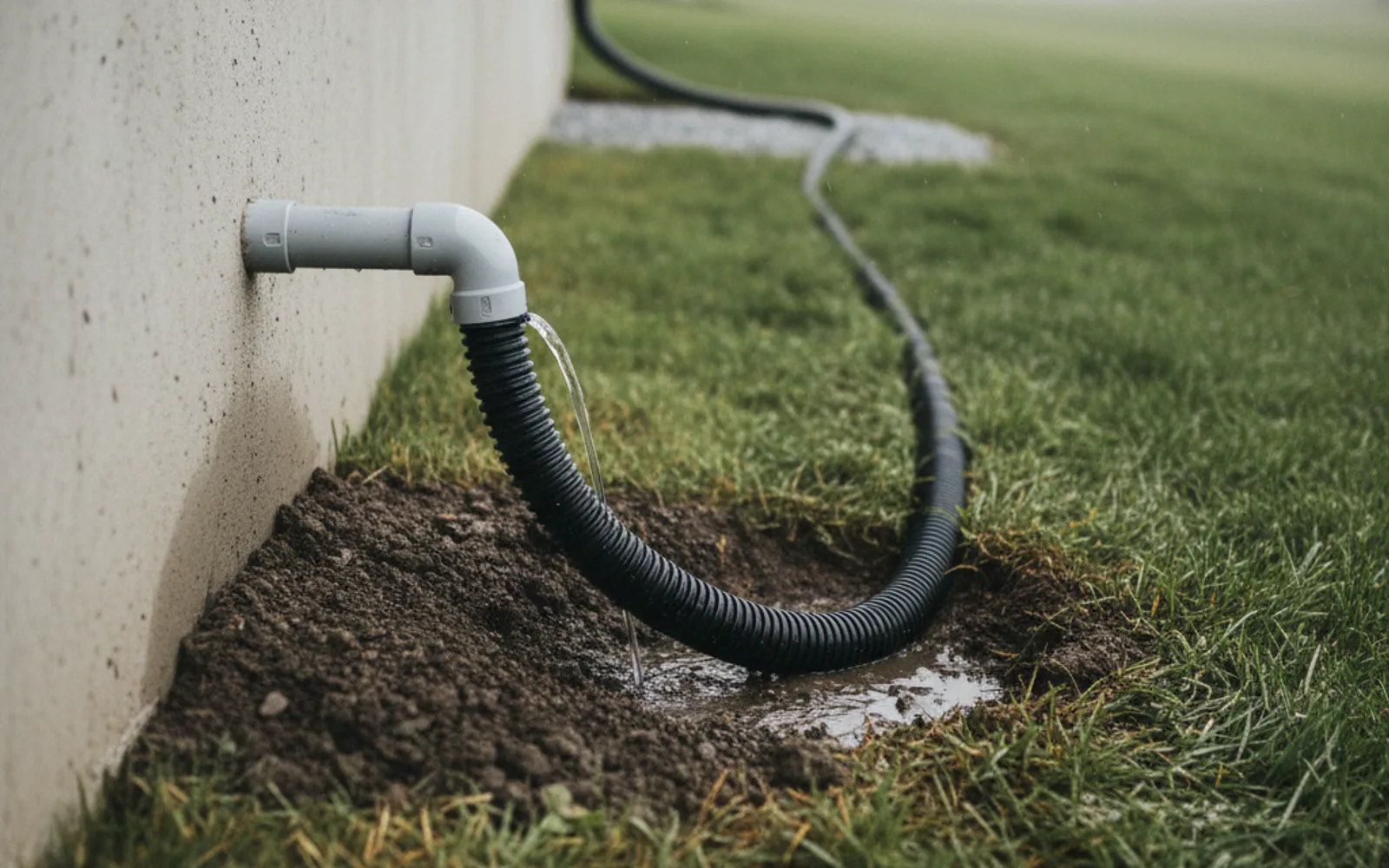
A discharge belongs well clear of the foundation, on a slope, and out of the sanitary sewer. That last part is a drawback owners create for themselves. A discharge piped into a floor drain, a laundry standpipe or the sanitary stack sends groundwater into a pipe that was sized for sewage. In a heavy rain every house on the street that does the same thing adds to the load, the sanitary main surcharges, and the sewer backup comes up through the floor drains, sometimes in the same basement the pump was meant to protect.
A backwater valve guards the floor drain against that backup and does nothing to keep groundwater out of the pit, because these are two separate problems with two separate fixes. Winter then adds a second problem at the discharge pipe, because sump pump discharge freezing blocks the outlet with ice while the pump keeps trying to push against it.
This drawback shrinks with a good outlet. It stays a seasonal check for as long as the pump is in the floor.
It costs money twice
The pit, the pump, the sealed lid and the discharge line are the first bill, and our page on sump pump installation for a Barrie basement covers that job. The backup and the alarm sit on top of it. Then the pump is replaced on its own schedule, which Barrie Fire puts at about 10 years depending on frequency of use, and the outlet and the battery need their spring and fall checks for the life of the house. What moves a job up or down inside that price band is covered on the cost to install a sump pump page.
Insurance is the second bill. The Insurance Bureau of Canada lists sewer backup among the optional coverages you may be able to buy separately, so check whether your policy carries it before you rely on the pump alone. Ask the insurer, in writing, whether a sump pump failure falls under that coverage on your policy.
The seventh: a good pump against the wrong problem
The worst sump pump is a good pump answering a question the house never asked. A pump only handles water that the weeping tile delivers to the pit. Water that comes over a settled grade, through a window well or down a wall crack above the footing never reaches the pit, and a new pump does nothing for that basement except cost money.
Sewer backup is the other mismatch. Water rising out of the floor drain while the pit stays low is coming from the sanitary sewer, and the fix for it is a backwater valve rather than any pump.
Before anyone cuts a slab, rule out the cheaper suspects first. Check that the downspouts carry their water away from the wall. Check that the grade still falls away from the foundation. Check that the window wells drain. Then ask whether the water could run downhill to an outlet below the footing. A gravity drain has no motor to wear out and no circuit to lose. For the house where gravity cannot do it, our post on the Ontario Building Code sump pump rules walks through the pit, the lid and the outlet.
Where that leaves most Barrie basements
In our view, four of the six machine drawbacks shrink to something small with the right parts: a backup for the power, a submersible pump with an overheating switch on its own circuit, a sealed lid, and an outlet that clears the backfill and does not freeze. Two stay with the house. The motor will wear out and someone has to test it twice a year, and the two bills keep coming.
What we need to say whether a pump is the right answer for your basement is where the water shows up and when it started. In our judgment those two answers are usually enough to tell a downspout from a drainage system, and to say whether this lot needs a pump at all. If you cannot tell, our sump pumps service page is the place to start.