
A crack caused by clay and a crack caused by a downspout look alike from inside the basement, but they are not two versions of one problem. Clay moves a foundation in three ways: it swells against the wall when it takes up water, it shrinks under the footing when tree roots dry it out, and it heaves when the backfill freezes. The downspout only feeds the clay. The single thing that decides between them is what your own lot is sitting on, and in Barrie that is not one soil.
What the county survey says sits under Barrie
The place to start on the lot question is the federal Soil Survey of Simcoe County, which puts the main glacial lake deposits of the county near Coldwater, Elmvale, Stayner, Minesing and Beeton. Those deposits sit in the lower, flatter ground, the old bed of glacial Lake Algonquin, and the survey says their texture runs from silt loam to clay.
The middle of the county is a different picture. The survey describes gently undulating outwash sand plains across a large part of it, broken by clay plains and till uplands. Between Barrie and Orillia it maps the Vasey series as a sandy loam, less stony than Vasey soils elsewhere in the county. North of the city it notes gravel streaks that appear to be shoreline deposits of water levels 200 feet or more above Lake Algonquin.
The till deserves the attention. The survey describes it as a mixture of boulders, cobbles, gravel, sand, silt and clay. A mixture with clay in it behaves very differently from clean sand once it is wet and freezing.
The Schomberg series soils lie mainly in Tecumseth and West Gwillimbury. Mechanical analysis indicated about 50 per cent clay and 40 per cent silt in those materials, and it gives the average depth of the clay deposit as about 15 feet. A house near Beeton on that ground is a different case from a house on outwash sand.
The county map cannot tell you what is under your own footing. A lot may have been cut and filled when its subdivision went in, and the backfill against your wall may not match the ground a street away. Clay is a question to answer lot by lot, and the wall is the first place to look. The wall itself matters as much as the soil. A block wall from the 1960s answers soil pressure differently from a poured wall. Both come up in our basement waterproofing in Barrie work.
Swelling, shrinking and frost, in the order the wall feels them
Swelling comes first. Clay takes up water and grows, and the National Research Council’s digest on swelling and shrinking subsoils notes that swelling clays are usually found in lacustrine deposits of Central and Western Canada. Against a basement wall that growth becomes lateral pressure, and the wall bends at mid-height.
Shrinkage under trees comes second. An earlier NRC digest describes shallow foundations on thick clay in the more humid regions of Eastern Canada becoming seriously distorted as deep-rooted vegetation removes soil moisture that cannot readily be restored. The same digest records that large trees have been known to send roots horizontally to distances greater than one and a half times the height of the tree. A mature maple at the corner of the lot can be drying the clay under your footing without anyone seeing it happen.
Frost comes third, and it is the one that catches the outbuildings. The NRC digest on frost action says coarse sands and clean gravels do not heave, while fine sand and silts are very susceptible to heaving. It adds that when silts, sands or gravels are contaminated with clay, heaving ability is usually much enhanced and becomes less predictable. That describes a mixed till backfill. It also notes that clay soils normally hold more moisture than silts and sands. The water held in the backfill trench is what the frost has to work with.
The same digest says frost heaving is not usually a problem in heated structures, because heat lost from the building keeps the soil beside the foundation above freezing. Unheated detached buildings and unheated additions get no such help. The digest warns that frost heaving in the backfill can lift a foundation wall because the soil adheres to it. That is why the garage and the porch addition often move when the house does not.
The mark each one leaves
Swelling pressure leaves a horizontal crack across the middle of the wall, often with the wall leaning in along that line. Shrinkage leaves settlement on the side of the house nearest the trees, and it usually shows as a crack wider at one end, or one that steps through the joints of a block wall. Frost heave shows on the unheated parts of the property, as an addition that racks or a garage wall that lifts.
| Mechanism | Where it shows | Mark on the wall |
|---|---|---|
| Swelling | Basement wall under lateral pressure | Horizontal crack at mid-height, wall leaning in |
| Shrinkage | Side of the house nearest the trees | Crack wider at one end, or stepping through block joints |
| Frost heave | Unheated additions and detached buildings | Racked addition or lifted garage wall |
A vertical hairline crack of even width in a poured wall is none of these. That is the concrete shrinking as it cured, and the soil had nothing to do with it. To read the pattern, track the crack through a full year with a pencil mark at each end.
Rule out the water before you blame the clay
Clay only moves when its moisture changes. The cheapest moisture to change is the water your own house is feeding it.
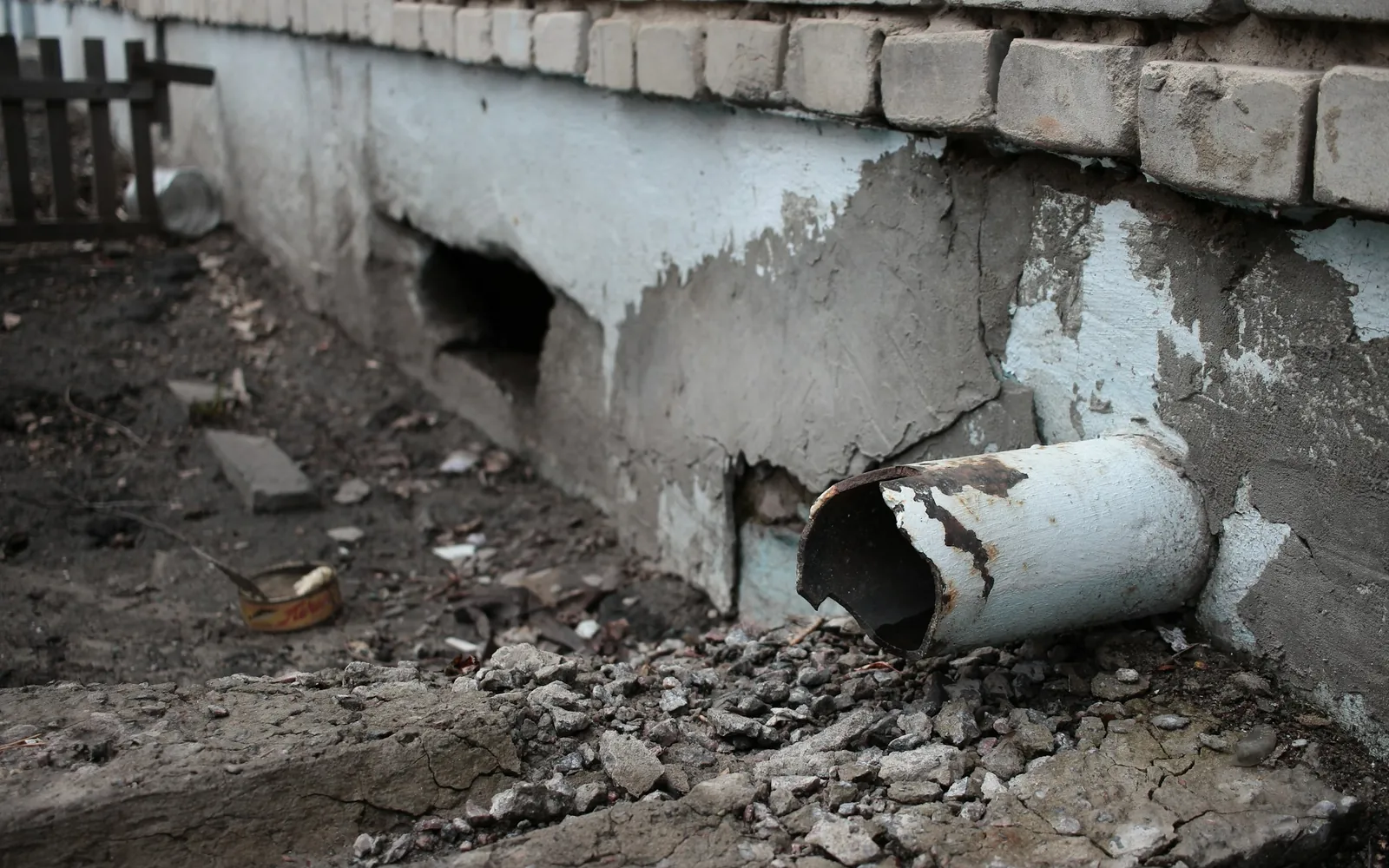
Start with the downspouts, because a downspout that empties beside the wall wets the backfill every time it rains, and wet clay swells. Then check the grade, because backfill keeps settling for years, and a lawn that once sloped away from the house often slopes back toward it now. Then look at where the driveway snow gets piled each winter. Each of these is a small job, and each one takes away water that both swells the clay and feeds the frost. In our judgement that is the first repair on any lot, whatever the lot is sitting on.
If the wall is also wet at the cove joint every March, the question is drainage as well as soil. Our page on basement flooding during the spring thaw in Barrie follows that water down the backfill trench to the footing.
Sealing the crack and moving the pressure are two jobs
Injection seals the crack you can see, and it does nothing about why the wall moved. If saturated clay is still pushing on the wall, the sealed crack can stay dry while a new one opens beside it. Injection is the right job for a leaking crack in a wall that has stopped moving. That is what foundation crack repair in Barrie is for, with polyurethane for the leak and epoxy where the wall has to act as one piece again.
A wall that is still moving needs the pressure behind it dealt with. Sometimes that means the downspouts and the grade above. Sometimes it means drainage at the footing, through weeping tile replacement in Barrie where the original tile has failed, or exterior waterproofing in Barrie where the wall has to be dug out and treated from the outside. A bowing wall may need bracing on top of either.
That decision is not one we should make alone, because the contractor who reads a moving wall is usually the one who would sell the fix for it. Get a structural engineer who is not quoting the repair to say whether the wall needs bracing, drainage or both, then have the work priced against that report.
The same caution applies to the trees. Cutting down the maple changes the water in the clay again, in the other direction. The NRC record concerns tree removal before construction. Ask an engineer before the saw comes out.
What tells the two cases apart
Two facts usually do it: which way the crack runs, and whether it has moved over a full year. With those and a walk around the outside of the house, it is usually possible to say whether the soil is moving the wall or water is coming through a crack that has stopped. The first case calls for an engineer’s report and then the work the report names. The second is a crack injection, and the crack repair page sets out what goes into that price.